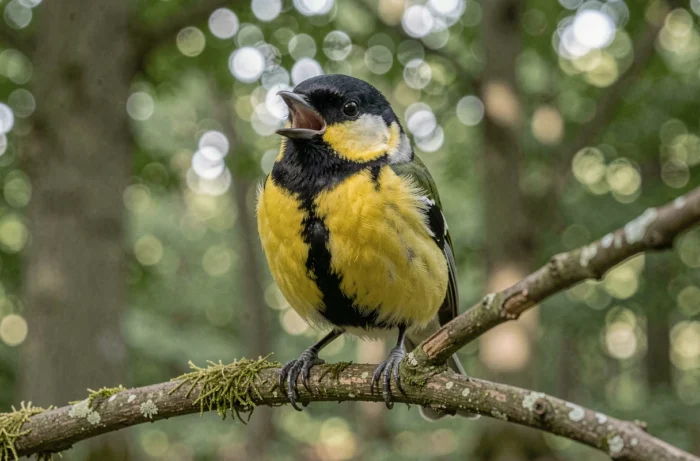
The song transcribed as “eight eight eight” points to the chaffinch (Fringilla coelebs), whose descending terminal phrase ends with a series of whistled notes that the French-speaking ear spontaneously transcribes with this onomatopoeia. We find this motif in almost all recordings of territorial males during the breeding season, from early spring until mid-June depending on the latitude.
Acoustic motifs of the chaffinch: anatomy of a song phrase
The complete song of the chaffinch lasts on average two to three seconds. It is divided into three segments: a series of rapid ascending notes, a central accelerated trill, and then the famous descending ending, the “eight eight eight.” It is this last portion that serves as a reliable signature in the field.
A study covering over 116,792 recordings of 3,160 species of passerines identified eight major recurring sound motifs in bird songs. On average, a species uses only five. The chaffinch combines modulated whistles, trills, and a final descending note, a combination that clearly distinguishes it from species with comparable repetitive songs.
When trying to identify the bird that sings eight eight eight, we recommend focusing on this ending rather than the beginning of the phrase, which is often drowned out by the ambient noise of the garden or forest edge.
The most common confusion concerns the wilow warbler, whose bisyllabic song “tsip-tsap” can evoke a repetitive motif. The difference is structural: the willow warbler alternates two notes without a descending melodic variation, while the chaffinch strings together a complex phrase before concluding with its low notes.

Chaffinch or serin cini: distinguishing criteria in the field
The serin cini (Serinus serinus) produces a continuous, rapid, and high-pitched song, sometimes perceived as a metallic fizz. Inexperienced observers confuse it with the chaffinch because both frequent the same parks and gardens in spring.
The distinction relies on three complementary criteria:
- The duration of the phrase: the chaffinch sings in short phrases interspersed with pauses of several seconds, while the serin delivers an almost continuous flow for ten to fifteen seconds
- The melodic structure: the chaffinch produces an organized phrase with an identifiable beginning, middle, and end, whereas the serin spews out a torrent of notes without clear segmentation
- The postural context: the serin often sings while fluttering in circles above its territory, while the chaffinch sings perched, usually on an unobstructed branch
If you hear a clear “eight eight eight,” with pauses between phrases and a bird stationary on a visible perch, you are facing a chaffinch.
Sound identification by application: what BirdNET captures and what it misses
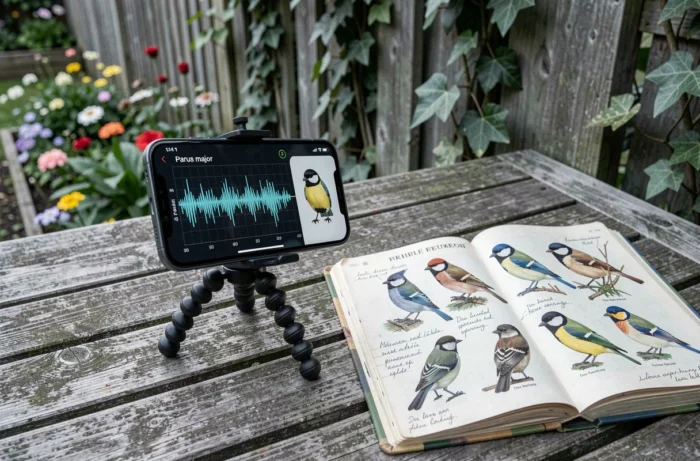
BirdNET, in its recent version called BirdNET Live, now works completely offline and covers about 8,927 species of birds. Processing on the device eliminates the delay of sending to a server, which changes the game for real-time identifications in the field.
We observe that the application excels at songs emitted in a calm environment, at moderate distances. However, the “eight eight eight” ending of the chaffinch, relatively brief, may be truncated if the recording starts too late or if another bird sings simultaneously.
To increase reliability:
- Start the recording as soon as the first notes of the phrase are heard, not just on the ending
- Record at least three consecutive phrases so that the algorithm has multiple samples
- Avoid very windy mornings, as the low-frequency background noise of the wind greatly degrades the detection of the chaffinch’s whistles
The approach based on sound motifs (whistles, trills, descending notes) used by recent models goes beyond simple comparisons of spectrographic fingerprints. It allows for classifying a song even if the recording is partial, as long as the characteristic ending is captured.
Period and habitat: when and where to listen to the song of the chaffinch
The chaffinch sings almost exclusively from February to June, with a peak in vocal activity in March-April. Outside of this window, the territorial male becomes almost silent. If you hear an “eight eight eight” in the middle of summer, check that it is not a residual song from an unpaired male, which is rarer but documented.
The species frequents both deciduous forests and urban parks, orchards, and hedgerows. In the Mediterranean zone, we find it in riparian forests and olive groves, sometimes confused with the brambling (Fringilla montifringilla) in winter, although the latter does not produce the terminal phrase “eight eight eight.”
The song is emitted from a high and unobstructed singing post. A chaffinch perched halfway up a tree, repeating its phrase every ten to fifteen seconds with regularity, constitutes the most common observation scenario. The regularity of the cadence is itself an identification clue: few garden species maintain such a mechanical rhythm for long minutes.
The chaffinch remains one of the most widespread passerines in Europe. Its song, once the “eight eight eight” ending is memorized, becomes a reliable sound marker that the ear recognizes effortlessly from one season to the next.