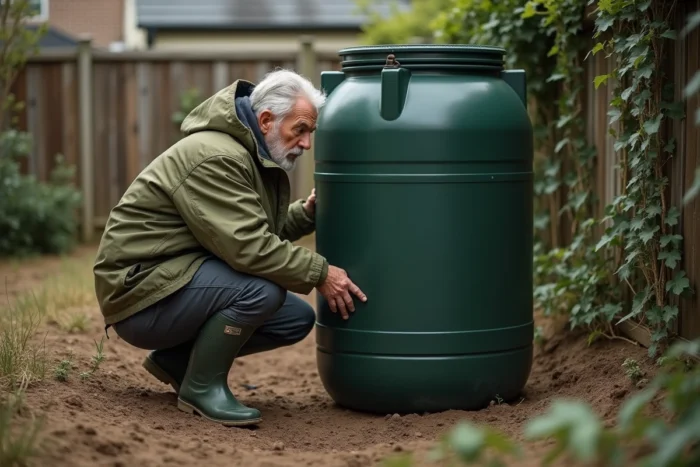
A rainwater collector that remains desperately empty despite recent rainfall indicates a malfunction in the collection chain, between the gutter and the tank. The problem rarely lies within the tank itself: it is the water’s path from the roof to the reservoir that requires a thorough inspection.
Clogged gutter collector: the first blockage point of the water collector
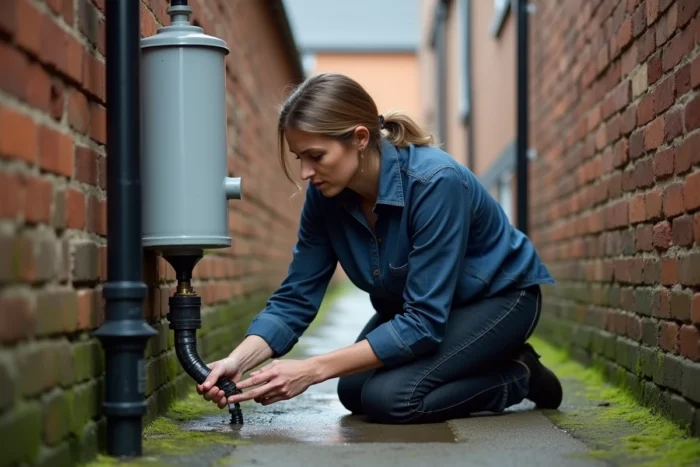
The gutter collector (or diverter) is the part that connects the downspout to the tank. Its built-in filter traps leaves, moss, and grains of sand. When this filter becomes clogged, rainwater continues its descent into the drainage system instead of being diverted to the collector.
A partially blocked collector may give the impression that the tank is filling very slowly, while in reality, most of the flow is bypassing it. Disassembling and cleaning this part at least twice a year resolves a significant number of cases of empty collectors.
The type of collector also plays a role. Guillotine models allow more debris to pass through than basket-filtering collectors. If you are trying to understand why my rainwater collector remains empty on Instant Jardin, the diagnosis almost always starts with this part.
Another common pitfall: the collector installed too low on the downspout. Water only reaches the diversion point when the flow is sufficient, which excludes light rains. Raising the collector by a few dozen centimeters improves capture during light showers.
Roof surface and connections: sizing rainwater collection
The roof area actually connected to the collector determines the volume of recoverable water. A common mistake is to connect only one downspout to a house that has three or four. The collector then receives only a fraction of the rain captured by the roof.
The roof material also influences efficiency. Smooth tiles and slate provide better runoff than green roofs or porous coverings, which absorb some of the rain before it reaches the gutter.
Check the tightness of the circuit between gutter and tank
Each connection between the gutter, the collector, and the supply pipe is a potential leak point. A poorly tightened joint or a detached pipe can lose the entire flow during moderate rains, as the flow remains low.
The check is simple: pour a bucket of water into the gutter upstream of the collector and observe the path. If the water does not reach the tank, the problem lies between these two points. Inspect the connections one by one.
- O-rings of the collector: they harden over time and lose their tightness, especially after several winters of frost.
- Supply pipe bent or crushed: a too-tight bend creates a hydraulic blockage that prevents water from flowing to the tank.
- Protective grille at the tank entrance: if it is clogged with plant debris, water overflows around it instead of entering the reservoir.
Evaporation and slow leaks: when the collector empties after filling
A collector that fills properly but is empty a few days later presents a different problem. Two main causes dominate: slow leak at the draw-off tap and accelerated evaporation.
The drain tap, located at the bottom of the tank, is often plastic. Insufficient tightening or a worn seal causes a continuous seepage. A few drops per minute, multiplied over several days, can empty a domestic-sized tank without visible signs on the ground if the water seeps directly into the soil.
Evaporation and sun exposure
A tank exposed to full sun loses water through evaporation, especially if the lid is not perfectly closed. Dark-colored tanks heat up more and amplify this phenomenon.
Placing the collector in the shade, against a north-facing wall, reduces losses. A well-fitted lid also limits the growth of algae and mosquitoes, two nuisances associated with open or poorly covered tanks.
Dryness and altered rainfall patterns: an empty collector despite correct installation
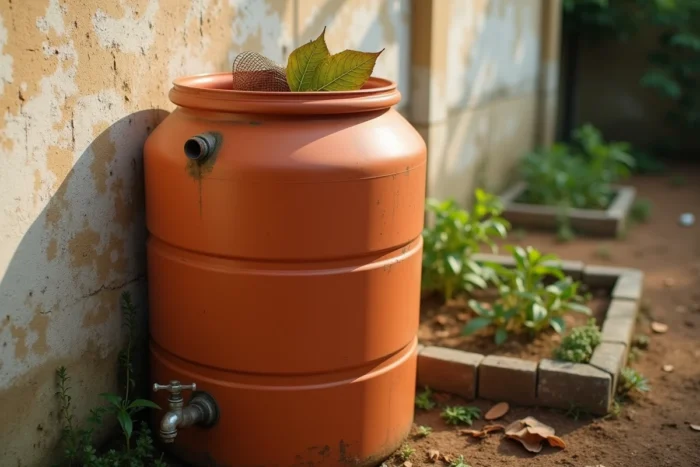
In recent years, several regions in France have experienced episodes of drought with a marked decrease in autumn and winter rains. A collector may remain empty not due to a technical defect, but simply because precipitation is insufficient to fill the tank.
The Rhin-Meuse Water Agency emphasizes that increased evaporation related to higher temperatures reduces the actual availability of rainwater for individuals. Communities under drought vigilance find that the volumes collected remain significantly lower than estimates based on past climate data.
This observation changes the sizing logic. Relying on historical rainfall averages to choose the size of the tank leads to an overestimation of the recoverable volume. A large-capacity collector does not provide any additional benefit if the rains do not come to fill it.
Adapting usage to climatic reality
When rains become scarce, managing the stock becomes a priority:
- Reserve collected water for high-value uses (targeted watering of fragile plants, occasional cleaning) rather than lawn watering.
- Connect multiple downspouts to the same tank to maximize capture during rainy episodes.
- Couple two tanks in series if space allows, to store a larger volume during intense rains that are becoming less frequent but more concentrated.
An empty rainwater collector does not always have a single cause. The diagnosis first involves the collector and the connections, then the condition of the tap and the lid, and finally a reassessment of the volume of rain actually available. Cleaning the collector filter twice a year remains the action that, by itself, resolves the majority of situations.