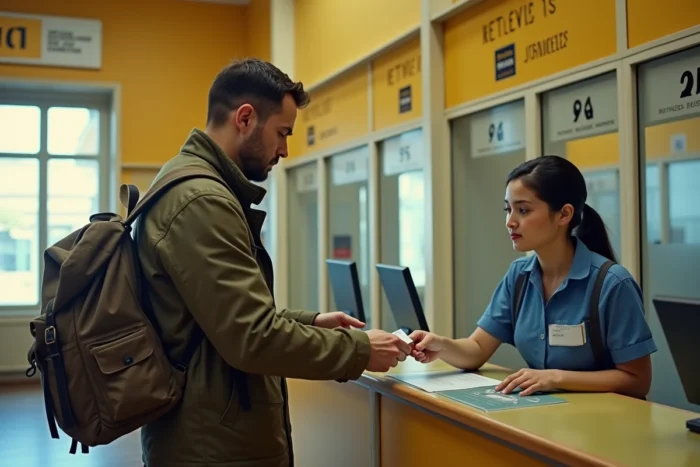
Receiving mail without a fixed address remains a concrete need for thousands of people in France: long-term travelers, seasonal workers, individuals in housing transition. Poste restante is the oldest system to address this, but its actual operation has constraints that are rarely detailed, notably a unique contract rule that can block any subscription.
Unique postal contract rule: the technical point to check before anything else
La Poste applies a little-known rule: only one active contract at a time per user. Whether it’s a temporary forwarding, mail holding, or poste restante, these services are mutually exclusive. If you have already subscribed to a forwarding service to a previous address, the request for poste restante will be denied until the previous contract is closed.
This administrative lock creates a blind spot for people without a fixed address. A seasonal worker who is moving between two assignments in different regions may find themselves unable to quickly switch to poste restante if they activated a forwarding service a few weeks earlier.
The solution lies in the La Poste Customer Space, where it is possible to modify the end date of a temporary forwarding up to five working days before the deadline. Shortening the duration of the existing contract frees up the possibility of opening a new one, including a poste restante.
Before going to the post office, check the status of your active postal services online. To better understand how to collect mail at poste restante, you must first ensure that no competing contract is blocking the process.
Poste restante at the post office: what the service covers and what it excludes
The principle of poste restante is simple: you choose a post office, your correspondents send mail to your name with the mention “Poste restante,” and you collect it upon presenting an ID. The standard retention period is fifteen days for letters.
However, parcels sent by private carriers are not covered. Chronopost, DPD, GLS, or Mondial Relay operate on their own networks of pickup points. Only items sent through the postal network (letters, Colissimo parcels) are eligible for poste restante. For someone without a fixed address who orders online, this limitation requires checking the carrier used by the seller before confirming an order.
What documents are needed to collect mail at poste restante
Collection requires a valid ID (national identity card, passport). The post office will not hand over the mail to a third party, except with a specific power of attorney. This rigidity protects confidentiality but complicates life for people with reduced mobility or those frequently on the move.
- Valid identity card or passport: the only accepted document at the counter for collection
- “Poste restante” mention mandatory on the envelope, followed by the postal code and the name of the municipality of the chosen post office
- Collection possible only during the opening hours of the post office, no availability at an automated machine
- Mail not collected within the deadline is returned to the sender, without systematic notification to the recipient
Alternatives to poste restante for people without a fixed address
Poste restante functions as a temporary safety net. For a lasting situation, other systems deserve to be evaluated, each with its own limitations.
The classic post box offers a dedicated number and access during the post office’s opening hours. It is suitable for professionals or individuals settled in a stable geographical area, but its monthly cost makes it less suitable for the constrained budgets of homeless individuals.
Approved associations provide free administrative domiciliation for people without stable housing. This domiciliation allows receiving mail but also completing administrative procedures (registration on electoral rolls, applying for social benefits). The CCAS of the municipality of attachment directs to the competent structures.
Online private domiciliation services
Companies offer a postal address with digitization of received mail. The principle: each envelope is scanned and can be viewed from an application. The physical mail can then be forwarded to the address of your choice, including abroad. This type of service is suitable for digital nomads or temporary expatriates who do not need to physically collect their letters.
Field returns vary on the reliability of these providers for registered mail. Some cannot sign on your behalf, which generates a delivery notice and a return to the sender. Before subscribing, explicitly check the handling of registered mail in the service conditions.
Postal distribution in France: a framework that remains stable in the short term
The debate over reducing mail delivery days in France has fueled concerns in recent years. According to information relayed in 2026 by RMC Conso via Ouest-France, La Poste does not plan to challenge the six weekly deliveries before 2036 at the earliest. For users of poste restante, this means that the delivery rhythm to post offices remains unchanged in the medium term.
This stability provides one more argument in favor of poste restante as a transitional solution. Mail continues to arrive daily at the post offices, which limits the delay between sending and availability at the counter.
- Six days of distribution maintained across the entire territory, including in rural areas
- No announced changes to the operation of poste restante in La Poste’s strategic plan
- The network of post offices remains the densest physical network for collecting mail without an address
Poste restante is not a perfect solution: restrictive counter hours, exclusion of private carriers, and difficulty in easily delegating collection. For a period of a few weeks to a few months, it remains the most accessible system without proof of residence. Beyond that, associative domiciliation or a mail digitization service takes over with more flexibility.