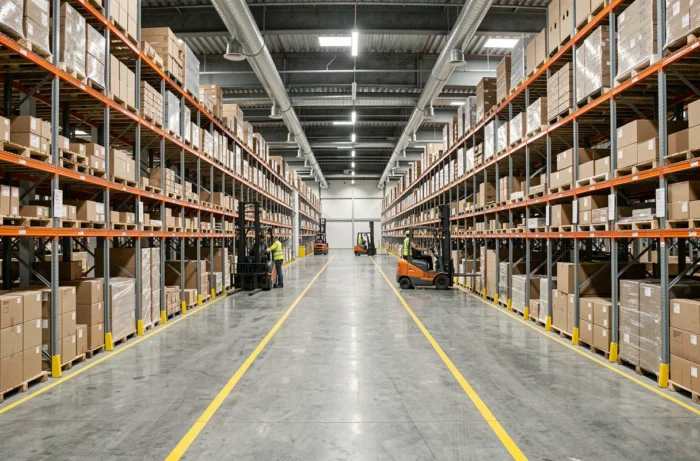
When managing a warehouse with 500 pallets and floor space is no longer sufficient, the choice of storage system becomes a trade-off between accessibility, cost per square meter, and turnover speed. Logistic storage solutions are primarily distinguished by their balance between storage density and ease of access to items. This comparison reviews eight concrete options, from traditional shelving to autonomous mobile robots, to identify the one that meets your operational constraints.
1. Classic pallet racking (selective rack)
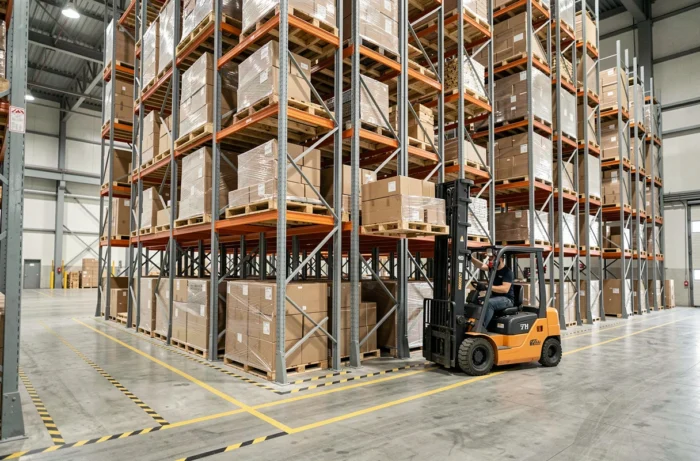
In a site where each item must remain individually accessible, selective racking remains the default solution. Each pallet has its own location, allowing direct access without moving other loads.
The main advantage: immediate access to all items without rotation constraints. Loading and unloading occur from the aisle, using a standard front forklift. Installation is quick, modular, and the cost per linear meter remains the lowest on the market.
The limitation quickly appears when available space decreases. Aisles consume a significant portion of the floor space. For a warehouse that stores few items in large quantities, this is not the right choice. However, for multi-item e-commerce with variable turnover, among the storage solutions offered by Annonces France, there are configurations suited to this type of need.
2. Accumulation rack (drive-in and drive-through)
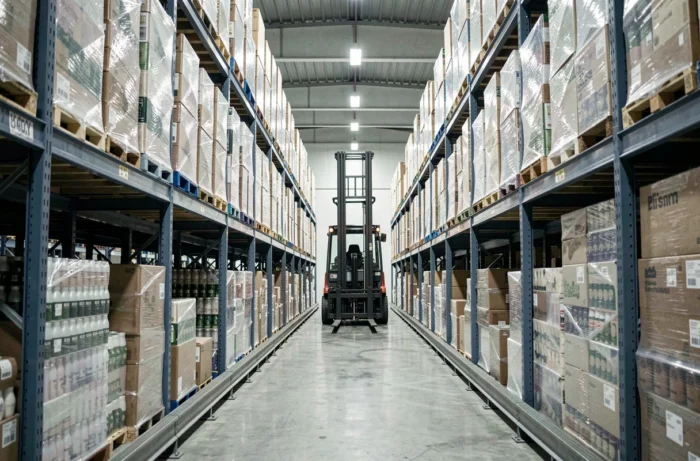
When storing large volumes of the same item (raw materials, seasonal products), the accumulation rack allows for up to one-third more space compared to selective racking. The forklift enters directly into the aisle to deposit or retrieve pallets.
The drive-in operates on a LIFO (last in, first out) basis, which is suitable for products without expiration dates. The drive-through, with access from both sides, allows for FIFO operation. The choice between the two directly depends on the turnover of the goods.
Note: maneuvering times are longer, and the risk of damaging structures increases with inexperienced forklift operators. This solution is reserved for homogeneous products with low diversity of references.
3. Shuttle system on rails
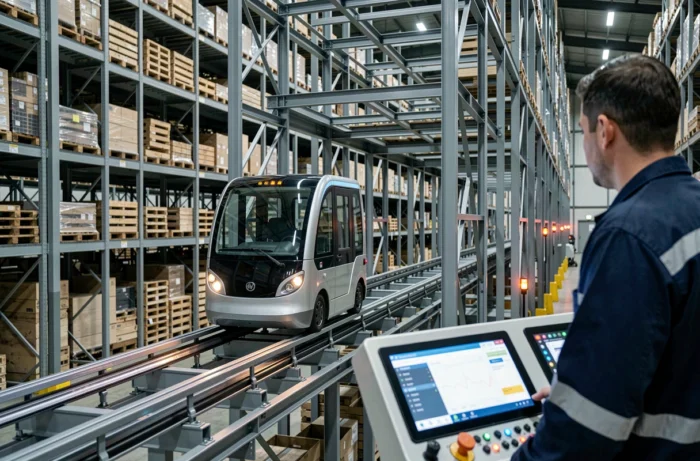
The shuttle represents a step up from the drive-in in terms of automation. A motorized shuttle moves along rails inside the aisles to transport pallets, without the forklift needing to enter the structure.
Density and safety are improved. The risks of collision with uprights disappear, and the throughput of pallets per hour significantly increases compared to a manual drive-in. The system is generally integrated with a WMS to manage movements in real-time.
The main drawback remains the initial investment and dependence on the manufacturer’s maintenance. Returns on investment vary based on the volume handled, but this solution is justified from a sustained daily flow.
4. Dynamic gravity racking (FIFO)
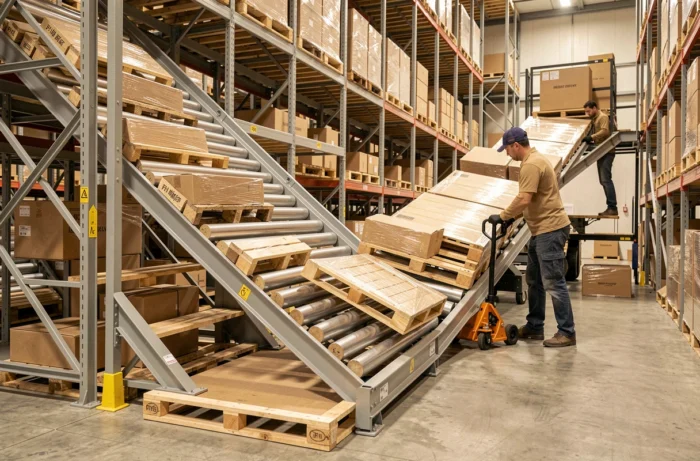
For the food industry or pharmaceuticals, where date management is non-negotiable, dynamic roller racking enforces a mechanical FIFO flow. Pallets loaded from one side slide by gravity to the picking side.
Stock rotation is guaranteed without human intervention or software configuration. It is the most reliable system to avoid expired products forgotten at the back of an aisle.
The cost per linear meter is higher than static racking, and the depth of the aisles must be precisely calibrated based on the weight of the loads. Poor sizing creates blockages or dangerous accelerations at the end of the line.
5. Industrial mezzanine (vertical storage)
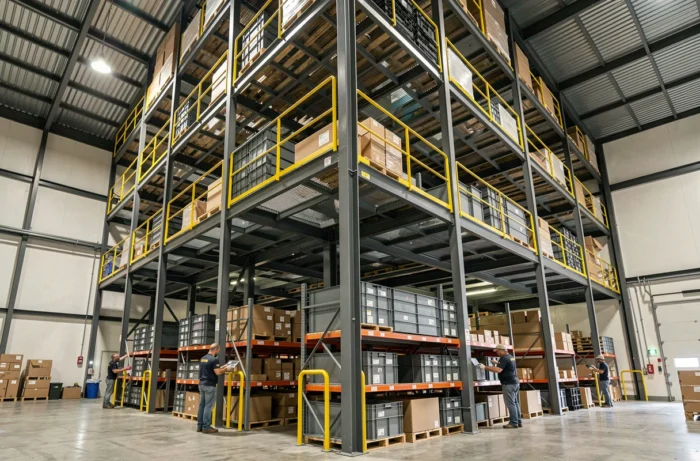
When land is expensive and ceiling height allows it, a mezzanine doubles or triples usable space without expanding the footprint. It is used for manual picking of small items, cardboard storage, or order preparation stations.
The mezzanine can be combined with any type of racking on the upper levels. Its installation requires structural validation (floor load, fire standards, emergency exits), but assembly times remain short compared to a building extension.
Concrete limitation: full pallets cannot pass through a mezzanine without a dedicated freight elevator, which adds a potential bottleneck.
6. WMS (Warehouse Management System) coupled with physical storage
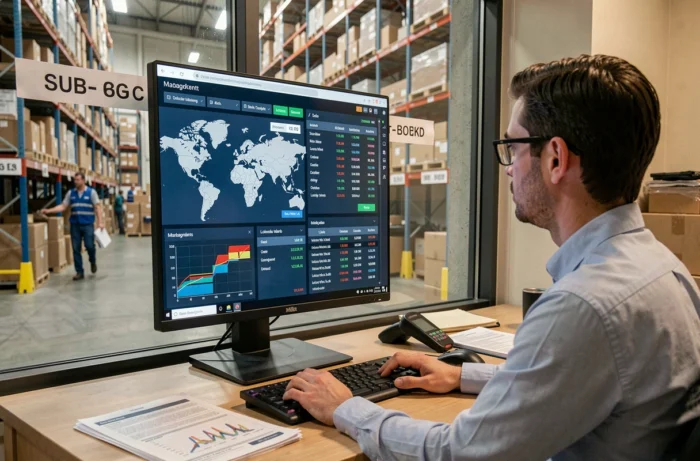
No physical storage system operates at full efficiency without software management. The WMS manages location assignments, replenishment of picking areas, cycle counts, and movement traceability.
- Dynamic location assignment based on rotation class (ABC method)
- Guidance for operators via mobile terminals or RFID to reduce picking errors
- Real-time inventory tracking with threshold alerts and ERP synchronization
A well-configured WMS reduces unnecessary movements and inventory discrepancies, regardless of the type of racking installed. The market is moving towards solutions that also integrate a WES (Warehouse Execution System) to orchestrate automated equipment.
7. Autonomous mobile robots (AMR) for picking
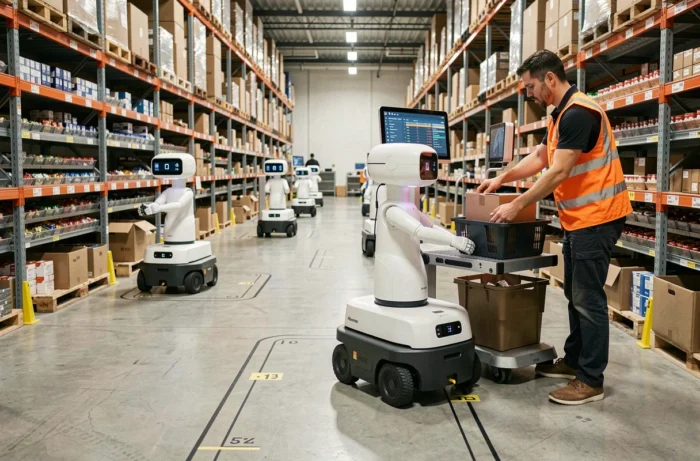
AMRs (Autonomous Mobile Robots) move freely within the warehouse to bring shelves or bins directly to preparation stations. The “goods-to-person” principle eliminates most operator movements.
Recent industry analyses confirm that the market favors targeted automation rather than fully autonomous warehouses. AMRs are gradually integrating into existing warehouses without complete reconstruction. The labor shortage in logistics accelerates their adoption, not to replace teams, but to secure operational continuity.
Deployment requires a flat floor, precise mapping of areas, and WMS/WES integration. The entry cost has decreased in recent years but remains a structural investment.
8. Logistics outsourcing (3PL) with shared storage
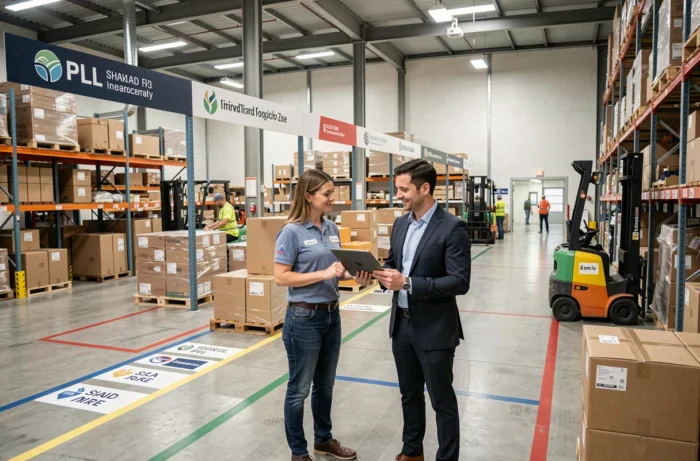
For a company with fluctuating volumes (product launch, seasonal peaks), outsourcing storage to a 3PL provider avoids investing in underutilized square meters for eight months out of twelve.
- Billing based on actual occupied volume, not reserved space
- Access to already equipped infrastructure (racks, WMS, loading docks)
- Rapid scaling without hiring or training
The compromise lies in control: you lose direct visibility over operations, and the quality of service depends entirely on the chosen provider. Checking SLAs (preparation times, error rates) before signing remains the minimum precaution. It is also worth noting that mandatory electronic invoicing starting in September 2026 in France requires checking the compatibility of invoice flows with your provider.
The right logistic storage system does not exist in absolute terms. A multi-item e-commerce warehouse does not have the same constraints as a food industry site with just-in-time flow. Starting from the actual turnover of products, the number of active references, and the available budget remains the most reliable method to arbitrate between these eight options.