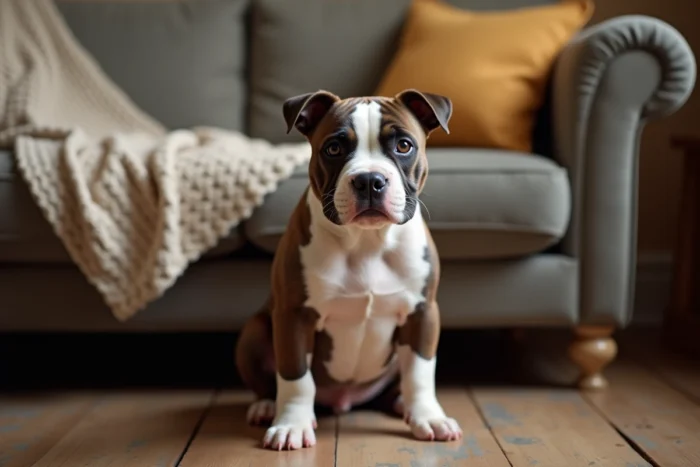
A stocky, muscular dog that fits in a small space and demands cuddles like a three-month-old puppy: this is what many owners describe when they talk about the mini staffie. The term circulates on forums, in breeder ads, and on social media. It actually refers to a small Staffordshire Bull Terrier, not a distinct breed. This distinction changes everything, from breeder selection to daily life with this companion.
Mini staffie and official breed standard: what really exists
No dog federation recognizes a variety called “mini staffie.” The standard for the Staffordshire Bull Terrier describes a compact dog with dense musculature, whose size remains moderate compared to other bull-type terriers. When an ad mentions a mini staffie, it refers to an individual at the lower end of the standard, or sometimes from undocumented crossings.
Why does this distinction matter? Because a serious breeder selects their breeding stock based on health and temperament, not on the promise of a miniature size. A so-called mini staffie is still a Staffordshire Bull Terrier, subject to the same requirements for sociability and robustness as any other dog of the breed.
For those who wish to delve deeper, you can learn everything about the mini staffie with Veritaxis before embarking on adoption.
The confusion with the larger American Staffordshire Terrier, which is subject to different legislation in France, remains common. The Staffordshire Bull Terrier, on the other hand, is not classified in category 1 or 2. The staffie is not a categorized dog, provided that its owner can prove its registration in the LOF (Livre des Origines Français).
Hereditary health of the Staffordshire Bull Terrier: risks to know before adoption
Content about the staffie often talks a lot about its character, but rarely about the genetic pathologies that affect the breed. Have you ever heard of L-2-hydroxyglutaric aciduria? This metabolic neurological condition, known by the acronym L2HGA, is one of the documented hereditary risks in Staffordshire Bull Terriers.
L2HGA causes coordination disorders, seizures, and behavioral changes. It is transmitted in an autosomal recessive manner: both parents must carry the gene for a puppy to be affected. A genetic test exists and allows for the exclusion of carrier breeders.
Before reserving a puppy, ask the breeder directly about this. A diligent professional conducts this screening and can provide the results. If the answer remains vague or evasive, change your interlocutor.
- Ask for the L2HGA test results for both parents, not just the mother.
- Ensure that the breeders are identified in the LOF, which guarantees the traceability of the lineage.
- Inquire about the history of hip dysplasia in the lineage, a common condition in compact and muscular dogs.
A breeder transparent about genetic tests is the first filter for selection. The price of a puppy guarantees nothing: only health evidence matters.
Temperament of the staffie: why this terrier sticks to its family
Since the official recognition of the breed in 1935, selection has shifted towards a dominant criterion: emotional stability in human contact. The Staffordshire Bull Terrier has been shaped to become an affectionate companion animal, not a guard or working dog.
In practice, a well-socialized staffie constantly seeks physical contact. It settles on your feet, follows every movement around the house, and demands attention with little nudges. This clingy temperament, sometimes described as intrusive, reflects a need for closeness ingrained in the breed’s selection.
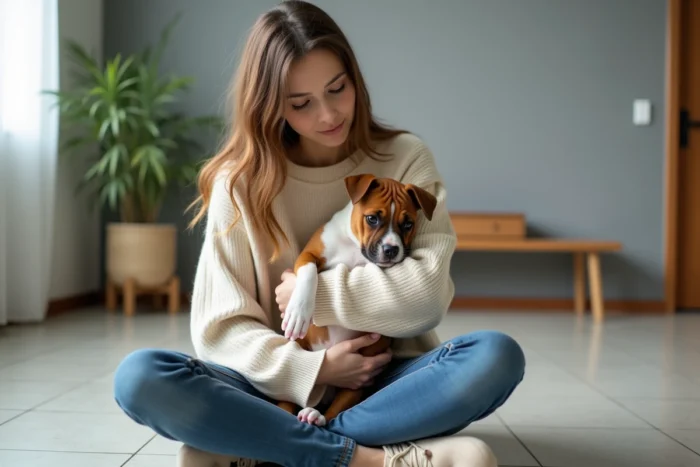
This closeness has a downside. A staffie left alone for several hours a day without preparation easily develops separation anxiety. The signs are concrete: destruction, prolonged barking, and messiness. Training for solitude should begin in the first weeks at home, with very short and gradual absences.
Sociability with children and other animals
The Staffordshire Bull Terrier is often described as an ideal family dog, and the reputation is well-founded. Its tolerance threshold for handling remains high compared to other breeds of similar size. It can withstand a child’s clumsiness without aggressive reactions, provided it has been properly socialized.
With other dogs, the issue requires more nuance. The staffie retains a background of reactivity inherited from its terrier past. Early socialization with other dogs is non-negotiable. A staffie that has not encountered any peers before four months will likely have difficulties on a leash or in a dog park.
Daily education of the staffie: channeling energy without breaking it
The Staffordshire Bull Terrier learns quickly, but it consistently tests limits. Its education relies on short repetition and immediate reward. Long sessions bore it, and harsh corrections make it stubborn.
Here’s how to structure daily learning:
- Favor sessions of five to ten minutes, two to three times a day, rather than a thirty-minute session that ends in frustration.
- Use chew toys as an alternative reward to treats; the staffie has a marked need for chewing that can serve as an educational lever.
- Work on recall in a closed space before any attempts in open areas, as the terrier’s reactivity to stimuli (other dogs, bicycles, runners) makes recall in open environments particularly demanding.
- Establish a routine for calming down after each outing: a dedicated mat, a “stay” exercise rewarded, to learn the transition between excitement and rest.
Consistency matters more than intensity in a staffie’s education. Ten minutes of structured work daily is worth more than an hour on the weekend.
The Staffordshire Bull Terrier is not a difficult dog to live with. It is a dog that requires presence, consistency, and a minimum of knowledge about its genetic health. If these three conditions are met, it becomes exactly what its nickname promises: a powerful, tender companion, remarkably attached to its family group.