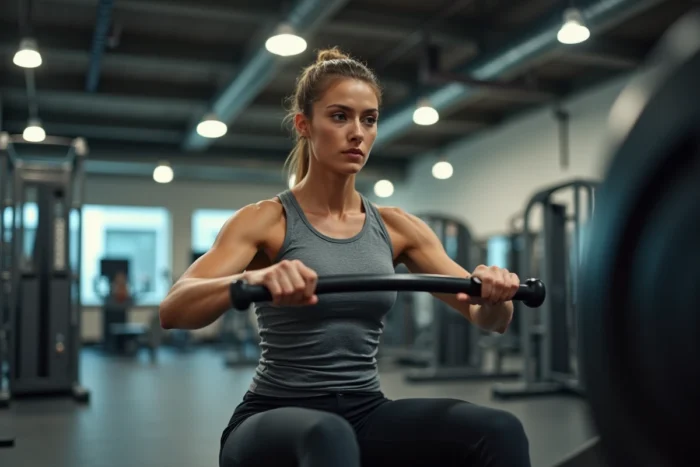
When you’ve been doing steady-state cardio sessions for weeks without seeing any difference in your waistline, the problem rarely lies in the lack of effort. It comes from the choice of machine and, above all, how you use it.
Love handles, this subcutaneous fat stored on the obliques and lower back, do not respond to the same stimuli as a simple linear caloric deficit. Some exercise machines allow for greater engagement of the abdominal muscles while creating a high energy expenditure, provided you work at the right intensity.
Why steady-state cardio is not enough against abdominal fat
We still see many practitioners spending forty minutes on an elliptical at moderate intensity hoping to target love handles. The problem is that spot reduction of fat does not exist. The body draws from its reserves globally, and the abdominal area is one of the last to deplete, especially in men.
Recent meta-analyses on the subject show that HIIT (high-intensity interval training) significantly reduces visceral and subcutaneous abdominal fat more than moderate-intensity cardio of equivalent duration, with an average difference of about 28% additional reduction in abdominal fat in the studied protocols. In practical terms, machines used in short, intense intervals far outperform the same machines used in continuous mode.
To get rid of love handles, it is therefore beneficial to schedule intervals above 80% of maximum heart rate rather than staying in a prolonged comfort zone.
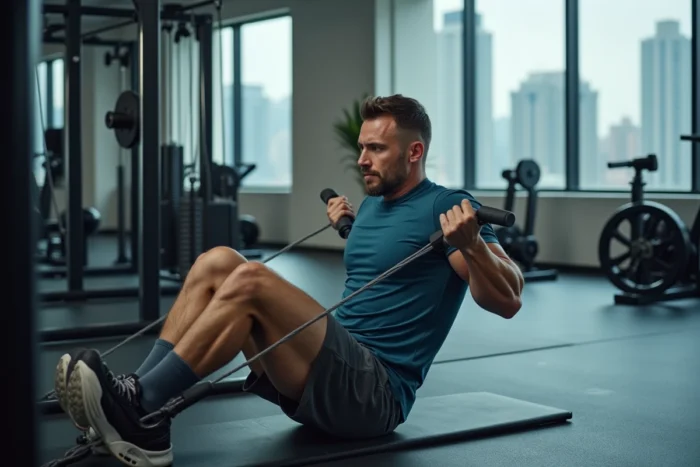
Rowing machine and air bike: the machines that engage the obliques in cardio
Not all cardio machines are equal when it comes to working the waistline. Two devices stand out for their ability to combine high caloric expenditure and muscle recruitment of the abdominal area.
The rowing machine, an underestimated dynamic core exercise
The rowing machine remains one of the few cardio machines that requires rotation and core stabilization with each stroke. The pulling motion engages the obliques, transverse, and spinal erectors in addition to the major muscle groups (back, legs, shoulders). This engagement of the core, repeated over hundreds of movements, makes it a formidable tool for the waistline.
In HIIT mode, a classic rowing protocol consists of alternating thirty-second sprints with one minute of active recovery, for a total duration of fifteen to twenty minutes. The perceived intensity should be maximal during the sprint phases. Feedback varies according to the level of practice, but most practitioners notice an impact on the abdominal area after a few weeks of consistency.
The air bike, the most aggressive calorie burner
The air bike (air resistance bike) uses both arms and legs simultaneously. The harder you pedal, the more resistance increases, making any attempt at a comfort zone practically impossible. The air bike generates one of the highest caloric expenditures among cardio machines, precisely because it engages the entire body.
The pushing-pulling motion of the arms creates a slight rotation of the torso that activates the obliques. During short intervals (ten to twenty seconds of maximum effort, forty seconds of rest), this device pushes the metabolism to its limits.
Incline treadmill: the accessible option for burning belly fat
The treadmill remains, in terms of gross caloric expenditure, the most effective machine in the gym. The reason is simple: running or walking while carrying your entire body weight requires more energy than assisted movements on a bike or elliptical.
The trick to better target the waistline on a treadmill is to increase the incline between 8 and 12% and walk briskly rather than run on a flat surface. Inclined walking recruits the glutes, hamstrings, and trunk stabilizing muscles much more intensely than regular jogging. You achieve a high heart rate without the joint impact of running.
An effective format: alternate two minutes of brisk walking at a high incline with one minute of flat walking, for twenty to twenty-five minutes. This type of session, repeated three times a week, perfectly complements a targeted strength training program.

Strength training on machines: the movements that matter for the waist
Cardio alone will not transform the oblique area. Strength training plays a direct role in shaping the silhouette by increasing local muscle mass and accelerating the basal metabolism. Three types of machines deserve attention:
- The high and low pulley, which allows for cable rotations (woodchop) and pulley crunches, two movements that directly target the obliques and the rectus abdominis with progressive resistance.
- The crunch machine, often neglected, which isolates abdominal work and allows for progressive loading without risk to the back, provided you control the eccentric phase.
- The horizontal pull, which engages core stabilization with each repetition and strengthens the stabilizing muscles of the spine, contributing to better posture and a visually flatter stomach.
The classic trap in the gym: limiting oneself to trunk flexion exercises (classic crunches) while forgetting about rotations and anti-rotation movements. The obliques, directly involved in the appearance of love handles, respond better to exercises that combine controlled rotation and lateral resistance.
Frequency and combination: how to structure the week
Using the right machine produces nothing without an appropriate volume and consistency. To achieve visible results on the waistline, it is ideal to combine:
- Three HIIT sessions per week on the rowing machine, air bike, or incline treadmill, lasting fifteen to twenty-five minutes each.
- Two strength training sessions including targeted exercises for the obliques and abdominal area (pulley, weighted crunches, side planks).
- A moderate caloric deficit through diet, without which no machine will produce visible results on subcutaneous fat.
Without dietary adjustments, even the best machine program remains insufficient. Love handles disappear when energy expenditure exceeds intake over time, not just during the session.
The choice of machine matters less than how you use it. A rowing machine used in intense intervals three times a week, combined with pulley strength training and controlled nutrition, will yield results far superior to an hour of daily elliptical on autopilot. Consistency and intensity make the difference, not the number of machines in the gym.