
Cutting your hair at home often starts with a simple desire: to refresh damaged ends or shorten an overly long fringe. The action may seem trivial, but without a method, the result can turn into a hair nightmare. The good news is that a few tips borrowed from professional hairdressers are enough to avoid most mishaps.
Cutting on dry hair: the rule that pros apply first
Have you ever noticed that your hair seems shorter after drying? It’s not just your imagination. Wet hair stretches under the weight of water, sometimes by several centimeters. By cutting on damp hair, you lose all visibility on the final length.
Hairdressers repeat: completely dry the hair before cutting allows you to see the actual length. This advice is even more crucial for curls, which shrink significantly when dried. On straight hair, the difference is more modest, but just half a centimeter too much can turn a maintenance cut into an unwanted shortening.
The other common trap is pulling the strand between your fingers to achieve a clean line. When you release, the hair returns to its natural position, and the result is shorter than expected. It’s better to let the strand fall freely, then cut with small vertical snips. If you’re looking for the latest on Blog Beauté, you’ll find before/after demonstrations that illustrate this difference in technique well.
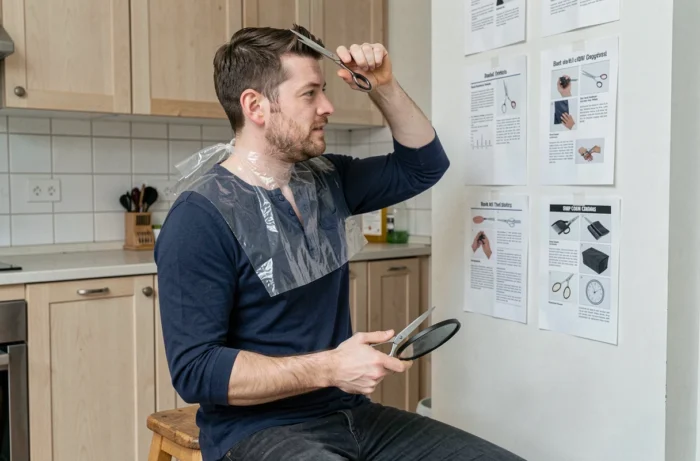
Home haircut: scissor position and vertical motion
The beginner’s reflex is to hold the scissors horizontally to draw a straight line in one go. Professional hairdressers do exactly the opposite. They orient the blades vertically relative to the strand and cut with small successive snips.
Why this choice? Scissors held vertically create a more natural result, without that stark line that betrays a home haircut. This motion, called thinning or “point cutting” in jargon, gradually removes bulk. If you take off too little, you can always go back. If you cut too much at once, it’s irreversible.
The right tools change the result
Kitchen or office scissors crush the hair fiber instead of cutting it. The result: split ends that appear a few days after the cut. Hairdressing scissors with sharp blades provide a clean cut that preserves the hair’s structure.
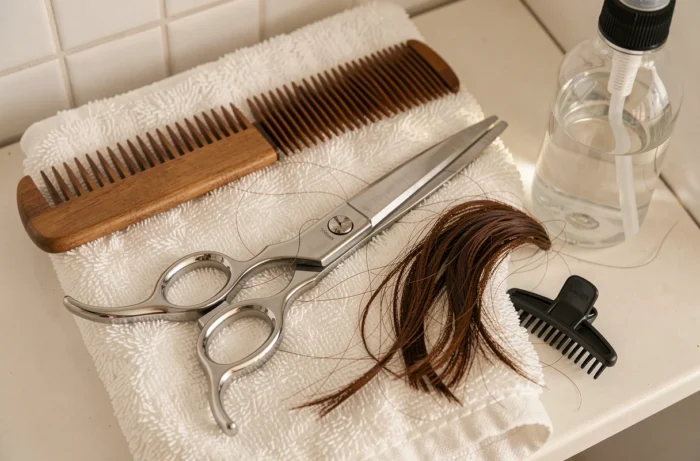
A fine-toothed comb helps to separate strands precisely. Clips or elastics allow you to isolate sections that have already been cut. With these three tools, you cover most needs for basic maintenance at home.
- Hairdressing scissors with straight blades for blunt cuts on ends or fringe.
- Thinning scissors (with a serrated blade) to reduce bulk without visibly shortening the length.
- Fine-toothed comb to create precise separations and isolate each strand before cutting.
- Flat clips to keep sections of hair out of the cutting area.
Fixing a botched haircut: hairdressers’ camouflage techniques
Public guides explain how to cut well, but almost none address the real urgency: what to do when it’s already gone wrong. Professionals follow a simple protocol in this case.
First rule: put the scissors down immediately. The temptation to correct by cutting more often worsens the problem in the vast majority of cases. It’s better to accept the temporary result and work with what remains.
Transforming a mistake into an intentional hairstyle
An overly short fringe can become “sheer bangs” by applying a small amount of balm or oil to the strands to create visible gaps. This style gives intention to the cut rather than an accidental look.
Mini clips, decorative pins, or a simple twist at the front of the head can also help secure the too-short strands by integrating them into a deliberate hairstyle. Using visible accessories transforms a flaw into a stylistic choice.
If the damage is more serious (marked asymmetry, very uneven length), consulting a hairdresser remains the best option. A professional can harmonize the cut by reworking the volume and contours without necessarily shortening it further.
Fringe and ends maintenance: frequency and suitable technique
The fringe grows faster than you think, because it is short and every millimeter shows. To keep it at the right length, cutting with small vertical snips every ten to fifteen days avoids having to remove too much bulk at once.
Place the fringe between your index and middle fingers, without pulling down, and cut the protruding ends while holding the scissors perpendicular to the strands. The result is more blended than a sharp straight line.
For the ends on longer hair, regular refreshing removes split ends and brings movement back to the cut. Divide the hair into several sections using clips. Work strand by strand by slightly twisting each section: the damaged ends naturally stick out from the twist and become easy to spot.
- Twist the strand in one direction, cut the ends that stick out, then twist in the other direction to catch the remaining ones.
- Only remove a few millimeters with each pass, even if you have to start over if the length still suits you.
- Work in front of a well-lit mirror, preferably in natural light, to see irregularities.
Cutting hair at home works as a maintenance technique between two appointments at the hairdresser. For any change in shape, volume, or structure, a visit to the salon remains the safe bet. The best home cut is one that limits itself to light maintenance on dry hair.