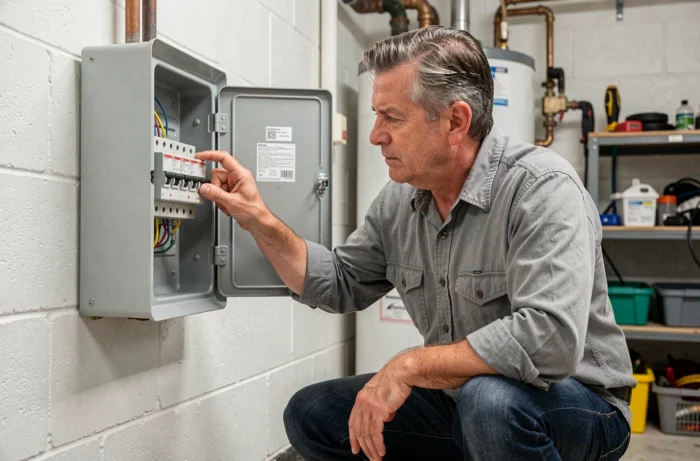
Locating the fuses and the fuse box in a house may seem trivial until a power outage plunges the home into darkness. The location of the electrical panel varies significantly depending on the building’s construction date and the standards in place at the time it was built. Understanding what determines this location allows one to find it without hesitation, even in a home that is not yet well known.
Location of the electrical panel according to the age of the home
The construction date of a house directly influences where to look for the panel and its fuses. Here is a comparison of the most common configurations.
| Type of housing | Probable location of the panel | Applicable standard |
|---|---|---|
| Old housing (before the 1990s) | Basement, cellar, detached garage, closet under the stairs, sometimes outside | No unified standard |
| Housing built between 1990 and 2015 | Entrance, pantry, attached garage | NF C 15-100 (earlier versions) |
| New or fully renovated housing (since the mid-2010s) | Technical housing duct (GTL), inside the housing or directly accessible annex | NF C 15-100 amendment A5 |
In a recent home, the search is much simpler. The NF C 15-100 standard requires the presence of a technical housing duct (GTL) that centralizes the electrical panel, the connection circuit breaker, and the communication box in the same location. The reserved space (called ETEL) must extend from floor to ceiling, with a minimum width of about 600 mm and a depth of about 200 mm, which prevents hiding the panel in a small closet or behind bulky furniture.
To delve deeper into the topic, a detailed guide on the location of fuses and fuse boxes on Habitat Solutions lists the most common configurations and the visual markers to know.
In older homes, however, no standardization existed. The panel may be found in a corner of the basement, mounted on an exterior wall protected by a metal box, or even integrated into a bedroom closet. These installations often use ceramic cartridge fuses, which look very different from today’s modular circuit breakers.
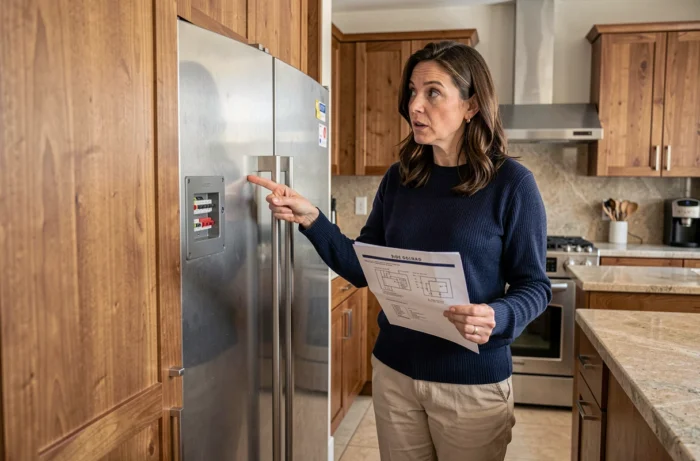
Cartridge fuses or modular circuit breakers: recognizing your installation
Finding the panel is not enough. You also need to identify what it contains. Two main types of protection coexist in the French residential sector.
Cartridge fuses
Cartridge fuses (or fuse circuit breakers) come in the form of small ceramic cylinders inserted into a fuse holder. When a circuit experiences an overload or a short circuit, the internal filament of the fuse melts and cuts off the current. The fuse is then out of service and must be replaced. To check its condition, a multimeter in continuity mode can determine if the filament is intact or broken.
Miniature circuit breakers
Miniature circuit breakers, found in more recent installations, serve the same protective function but simply reset by flipping the lever. No replacement is needed after a trip. They are recognizable by their small switch-like shape aligned on a DIN rail inside the panel.
The distinction has a direct practical consequence: with cartridge fuses, you need to keep a stock of spare fuses with the correct amperage for each circuit. With circuit breakers, a simple reset is sufficient after identifying and resolving the cause of the trip.
Concrete method to locate the fuse box room by room
Rather than a random search, a systematic approach saves time, especially in an unfamiliar or old home.
- Start with the entrance and hallways (corridor, vestibule). In most homes built after the 1990s, the panel is located in these passage areas, often high up behind a small white gate.
- Next, inspect the attached garage, pantry, or laundry room. These technical rooms often house the panel in single-family homes.
- Check the basement or cellar if the home has one. Older houses concentrated electrical equipment near the meter, which is often located in the basement.
- Look outside the building: some older homes have an external wall-mounted box, usually on the street-facing facade, near the connection point to the network.
A reliable marker is to follow the main power cable from the electrical meter. This cable leads directly to the connection circuit breaker (the main circuit breaker), which is located in the same box or right next to the distribution panel containing the fuses.
Labeling the electrical panel: avoiding a blackout in the dark
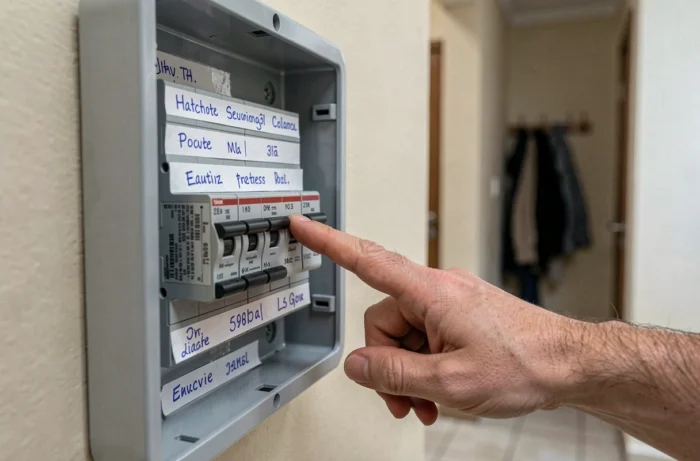
A found panel that is not labeled remains a problem. Each circuit protected by a fuse or circuit breaker powers a specific area of the home (kitchen, bedroom, living room outlets, water heater). Without labeling, identifying the correct fuse during a power outage requires a process of elimination, which takes time and carries a risk of error.
The NF C 15-100 standard requires a single-line diagram and readable labeling of each circuit in new installations. For older homes, creating this labeling oneself remains the most effective method.
- Turn off each fuse or circuit breaker one by one and note which area of the house loses power.
- Use a socket tester or a simple plugged-in device (lamp, radio) to check which outlet or lighting corresponds to each circuit.
- Record the results on a diagram attached inside the panel gate, using a moisture-resistant marker.
This operation takes about twenty minutes for a standard home. It prevents the need to fumble with multiple fuses during a nighttime outage.
In homes where the panel has remained unchanged for several decades, an electrician can check the overall compliance of the installation and propose a partial upgrade if cartridge fuses or inappropriate ratings are still in place. Locating the panel is the first step, but its contents deserve as much attention as its location.