
An official photo is an image published by the person concerned or by an authorized media outlet, with their explicit consent. A stolen shot, on the other hand, is captured without agreement, often cropped, recompressed, or shared out of context. In the case of Alicia Dauby and her husband Olivier Bossard, this distinction has become a recurring topic as images of the couple circulate on very different channels.
Distribution channel: the primary sorting criterion for a photo of Alicia Dauby
Before analyzing the image itself, the publication source often clarifies the issue in most cases. E-reputation specialists recommend only considering photos published on the verified accounts of the personality or shared by media outlets with a distribution agreement.
For the Dauby-Bossard couple, this means that a photo appearing on an unverified Instagram account, a forum, or a gossip blog cannot be treated as an official shot, even if it seems to be of good quality. An image shared by a gossip aggregator without identifiable photographer credit is, by default, suspicious.
Knowing how to distinguish Alicia Dauby’s photos relies first on this reflex: tracing back to the initial publication point rather than relying solely on the visual content.
Metadata and compression: what technical analysis reveals about an image
An official photo generally retains consistent EXIF metadata: camera model, date of capture, and sometimes GPS coordinates of the location. A stolen or manipulated shot often has absent, incomplete, or inconsistent metadata because the image has undergone multiple recompressions or successive screenshots.
Check metadata without complex software
On a smartphone, free reverse search tools allow you to trace back to the first known occurrence of an image on the web. Google Images and TinEye operate on this principle: you submit the photo, and the engine displays the pages where it appears, sorted by date.
If the first appearance of a shot of the Dauby-Bossard couple traces back to an official account or a partner media outlet, the likelihood that it is authorized is high. If the first occurrence points to an anonymous account or a site unrelated to the personality’s universe, caution is warranted.
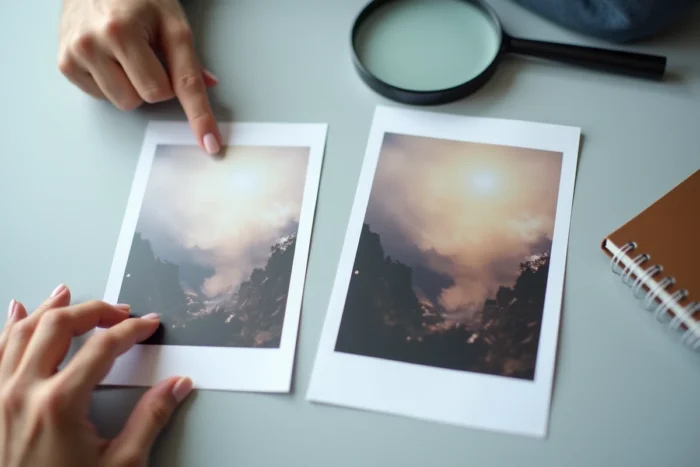
Visual signs of a recompressed image
AI authentication tools analyze pixel consistency, JPEG compression artifacts, and traces of algorithmic retouching. Without access to these tools, some clues remain visible to the naked eye:
- A localized blur around faces or backgrounds, indicating aggressive cropping from a wider photo
- Pronounced compression halos on the edges, typical of an image saved and re-saved multiple times
- A very low resolution compared to current standards of professional devices, suggesting a screenshot rather than a direct download
Celebrity agencies now use these AI image authentication tools to filter supposedly official shots before any public dissemination. This practice reinforces the boundary between authorized content and wild content.
Image usage charters: a game-changing framework
Several public figures, faced with the uncontrolled circulation of their photos, now publish usage charters for their images directly on their official accounts. These documents specify the conditions for reuse, prohibit edits, and define the expected reaction in case of paparazzi incidents.
The Dauby-Bossard couple is part of this trend observed since 2023 among certain media-savvy couples. Their strategy is to refuse to comment on any photo circulating outside their official channels, even to deny it. The goal is to not legitimize stolen shots and to discourage accounts specializing in unauthorized content.
Why silence in the face of stolen shots is strategic
Publicly reacting to a stolen photo produces a paradoxical effect: the denial draws attention to the image and gives it visibility that it would not have obtained on its own. By choosing to only disseminate controlled visuals and never interact with wild content, the personality creates a sharp contrast between their channels and the rest.
For the public, this communication policy becomes an additional indicator. If a photo is not shared by either Alicia Dauby or Olivier Bossard on their networks, and no identified media credits it, it very likely falls under the category of unauthorized shots.
Practical checklist for authenticating a public figure’s photo
Before sharing or believing an image, a few quick checks can eliminate the majority of dubious content:
- Identify the account or site that first published the image using reverse search (Google Images, TinEye)
- Check if the source account is verified or explicitly linked to the personality
- Observe the technical quality of the shot: resolution, compression artifacts, consistency of lighting
- Look for photographer credit or copyright mention on the image or in the caption
- Consult the official accounts of the personality to see if they have shared or mentioned this visual

The distinction between an official photo and a stolen shot relies less on the content of the image than on its distribution path. A technically impeccable visual can be stolen, and a photo of average quality can be perfectly authorized. The publication channel remains the most reliable criterion, ahead of technical analysis and the communication policy of the person concerned.