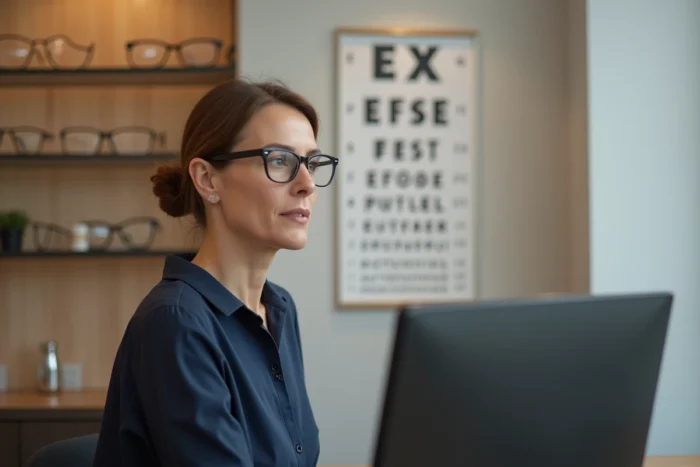
A correction of 0.75 diopters, whether positive or negative, falls within the lower range of ametropias. This value frequently appears on ophthalmic prescriptions, both in sphere and cylinder, yet its clinical interpretation varies depending on the refractive context. Understanding what this number encompasses helps avoid two symmetrical errors: neglecting a real functional discomfort or over-correcting an eye that does not need it.
Correction 0.75 diopters: clinical threshold in refractive surgery and presbyopia
In refractive surgery, a difference of 0.75 diopters between manifest refraction and cycloplegic refraction serves as a warning signal. According to CRSToday Europe, when this difference is reached, specialists recommend prescribing glasses temporarily to reveal any latent hyperopia before considering laser treatment.
This threshold is therefore not insignificant in specialized ophthalmological practice. Devices used in the United States are approved to adjust from 0.75 to 2.00 diopters of cylinder post-cataract surgery, indicating that this value is the floor from which a corrective intervention on astigmatism is justified.
Regarding presbyopia, recent optical guides position +0.75 as an entry threshold for reading glasses. Early presbyopia can appear as soon as +0.25, but it is around +0.75 that discomfort in near vision becomes sufficiently regular to warrant equipment. In practice, we observe that this stage corresponds to when the patient begins to hold their phone or book further away.
When seeking to understand the correction 0.75 for glasses, it is essential to keep in mind that the sign in front of the value radically changes the situation: -0.75 pertains to mild myopia, while +0.75 pertains to hyperopia or early presbyopia.
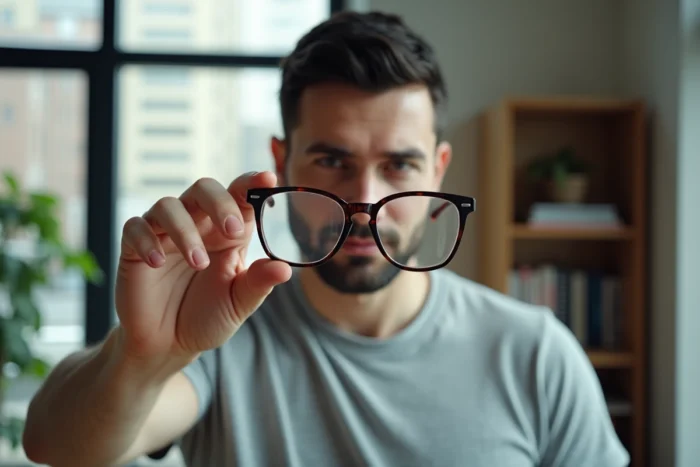
Myopia of -0.75 and hyperopia of +0.75: two corrections, two visual realities
A myopia of -0.75 primarily affects distance vision. The point of clarity is located about one meter in front of the eye. Discomfort is mainly experienced during night driving, at the cinema, or when facing a conference board. In contrast, near vision remains comfortable without correction.
Hyperopia of +0.75 works in the opposite way. The eye at rest focuses behind the retina. In a young subject, accommodation compensates for this deficit without difficulty, and many wearers remain unaware of this ametropia for years. Visual fatigue at the end of the day and frontal headaches after prolonged reading are often the first symptoms.
Astigmatism of 0.75 (noted in parentheses on the prescription, with an axis in degrees) blurs contrasts in all directions affected by the axis. A cylinder of this value, combined with even a low sphere, can significantly degrade visual comfort on screens.
Permanent wear or occasional wear at 0.75 diopters
We recommend distinguishing three situations:
- Isolated myopia of -0.75: wearing advised for driving and activities requiring clear vision beyond a few meters, but not necessarily continuously
- Hyperopia of +0.75 in a person over 40: near-permanent wear recommended, as the accommodative reserve decreases and natural compensation becomes insufficient
- Astigmatism of 0.75 associated with prolonged screen work: permanent wear preferable to limit visual fatigue and headaches
The need to wear glasses depends more on the visual context than on the raw value. A road driver with -0.75 needs their lenses more than a hyperopic retiree with +0.75 who reads little.
Choice of lenses and indices for a correction of 0.75
At this power, the thickness of the lenses remains minimal regardless of the index chosen. A lens with an index of 1.5 (standard) is sufficient in most cases. Moving to an index of 1.6 or 1.67 is only justified for very thin or full-rim frames where even the slightest visible edge poses an aesthetic problem.
The additional cost of a high index does not provide any optical gain for such a low correction. We recommend instead investing in a quality anti-reflective treatment and a blue light filter if the patient works on a screen, as these treatments improve perceived comfort more than thinning the lens.
Contact lenses at 0.75 diopters
Daily soft lenses are available in this power, both spherical and toric to correct astigmatism. Tolerance is generally good. However, toric lenses of 0.75 in cylinder can sometimes be more challenging to stabilize on the eye due to the slight curvature difference between the two meridians.
For isolated astigmatism of 0.75, some prescribers prefer an equivalent spherical lens rather than a toric one, accepting a slight compromise on clarity. This choice depends on the patient’s sensitivity to contrasts.

Evolution of a correction of 0.75: monitoring and renewal
A low correction does not mean a stable correction. In children and adolescents, myopia of -0.75 can progress rapidly to higher values. Annual follow-up remains the rule, and myopic control techniques (defocusing lenses, orthokeratology) can be discussed at this stage if progression is documented.
In adults, hyperopia of +0.75 diagnosed after 40 years evolves little in sphere, but the presbyopic component gradually adds up. The near addition increases by about one diopter per decade, which ultimately transforms a simple prescription into a progressive lens prescription.
- Renewal of the prescription: every year before age 16, every three years between ages 16 and 42, every two years thereafter (unless associated pathology)
- The validity of the prescription allows the optician to adjust the correction within a defined limit, but an ophthalmological check-up remains preferable before any equipment change
- A change of more than 0.50 diopters between two visits justifies a supplementary examination to rule out an underlying pathology
A correction of 0.75 deserves the same rigorous follow-up as a stronger ametropia. The low value should not overshadow functional discomfort, nor delay appropriate equipment when symptoms are present.