
Parental burn-out is now recognized as a public health issue in France. This reality, documented by several specialized media outlets and relayed by organizations like Santé publique France, changes the way we can approach daily advice for parents. Rather than piling on additional injunctions, supporting parents first means assessing what is truly weighing on them, and then identifying the levers that can concretely lighten the load.
Parental burn-out and mental load: what recent data shows
Educational injunctions have multiplied in recent years: “perfect” parenting, academic performance, extracurricular activities, screen management. Each adds a layer of pressure that parents often absorb without measuring the cumulative effect.
Parental burn-out is not limited to fatigue. It combines prolonged emotional exhaustion, emotional distancing from the child, and a sense of inefficacy in the parenting role. Warning signs include disproportionate irritability, gradual disengagement from family activities, and persistent sleep disturbances.
Resources exist for distress situations: the general practitioner remains the first point of contact, a psychologist specializing in parenting can intervene, and 3114 (national suicide prevention hotline) is accessible for the most serious cases. Identifying these reference points before being overwhelmed is part of the most useful advice that can be conveyed, as parents on the Maman Bébé Conseils site remind us through their resources dedicated to parenting.
Child sleep and parental fatigue: an underestimated link
A child’s sleep directly conditions that of the parent. A baby who wakes up several times a night fragments the adult’s rest over months, sometimes years. This parental sleep deficit affects emotional regulation, patience, and decision-making ability.
Three factors influence the quality of sleep in young children more than others:
- The regularity of bedtimes, which synchronizes the biological clock much more effectively than an elaborate ritual
- Exposure to natural light during the day, which strengthens the wake-sleep cycle and facilitates falling asleep in the evening
- The temperature of the room, ideally kept cool, as an environment that is too warm causes frequent night awakenings
Acting on these three parameters produces measurable results in a few weeks. Improving the child’s sleep mechanically improves the parent’s mental health.
Development of autonomy: age group comparison
Encouraging a child’s autonomy reduces parental load while supporting their development. A common trap is to wait too long or to offer responsibilities that are inappropriate for their age.
| Age Group | Realistic Autonomy | Impact on Parental Load |
|---|---|---|
| 18 months – 3 years | Putting a toy in a bin, choosing between two pieces of clothing | Reduces the parent’s daily micro-decisions |
| 3 – 6 years | Dressing independently, setting the table with help, washing hands | Frees up time in morning and evening routines |
| 6 – 10 years | Preparing a simple breakfast, managing their backpack, participating in household chores | Significantly decreases constant supervision |
Autonomy is not taught in one lesson. It is built through repetition and tolerance for imperfection. A four-year-old putting their sweater on inside out is making progress: systematically correcting them hinders learning more than it helps.
Role of the parent in supporting autonomy
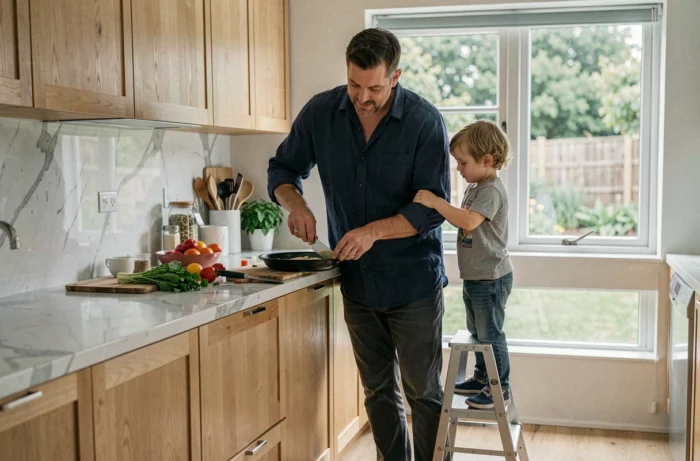
The parent’s role gradually shifts from “doing it for them” to “being available if needed.” This transition requires resisting the urge to intervene reflexively. A child struggling with their shoelaces for three minutes is not in trouble; they are learning.
Education for autonomy has a direct effect on the child’s emotions. A child who feels capable regulates their frustration better, which reduces tantrums and, in turn, parental exhaustion.

Screen management and digital support for children
A guide published by the CAF of Aude and relayed by UDAF 75 offers families a concrete framework to support the child in facing digital technology daily. The topic goes beyond simply limiting screen time.
This guide emphasizes co-use: watching content with the child, commenting on what they see, asking them questions. This approach transforms a passive moment into an educational exchange. For younger children, the recommendation remains to delay screen exposure for as long as possible, especially before the age of three.
Bouygues Telecom has also launched a solution dedicated to the first smartphone, designed to protect children during this stage, which often causes parental concern. The goal is not to prohibit digital technology but to structure access progressively, in line with the child’s development.
Digital parenting: local resources to know
The “Promeneurs du Net” program, active in several French departments, provides parenting professionals who intervene directly on social networks and digital spaces frequented by young people. These interveners are a valuable resource for parents who feel overwhelmed by their children’s digital usage.
Daily parenting is not just a checklist of good practices to tick off. Recent data on parental burn-out shows that the first useful piece of advice is to recognize one’s own limits. Working on sleep, gradually delegating through the child’s autonomy, and structuring access to digital technology are three concrete levers whose effects can be measured in weeks, not months.