
Leonard François, father of Naomi Osaka, was born in Jacmel, a coastal town in the southeast of Haiti. His journey, marked by transitions between three countries and two continents, has directly shaped the sporting and cultural trajectory of his daughter. Understanding his origins sheds light on part of the family project that produced one of the most decorated tennis players of her generation.
Jacmel, Haiti: The Starting Point That Biographies Overlook
Most portraits dedicated to Naomi Osaka mention her father’s Haitian origin in a single line before moving on to tennis. Leonard Maxime François grew up in a large family in Jacmel, in a modest environment. This town, known for its colonial architecture and cultural scene, is not just a biographical detail.
In 2026, Leonard François co-inaugurated with Naomi a renovated school building in Morne Ogé, near Jacmel, as part of an educational project. This physical return to his region of origin shows that the connection to Haiti goes beyond a symbol. It is not a passive heritage, but a concrete commitment that continues to shape the family’s choices.
To better understand the origins of Leonard François and Naomi Osaka, one must follow this thread between Jacmel, New York, and Japan, three spaces that have each left an imprint on the father’s educational method.
Leonard François Between Haiti, New York, and Japan: A Three-Step Journey
After his childhood in Jacmel, Leonard François pursued studies in the United States at New York University. It was during a university program in Japan that he traveled to Hokkaido, where he met Tamaki Osaka, his future wife.

The couple initially kept their relationship secret. Tamaki had grown up in a traditional Japanese family setting, where intercultural unions were not accepted. When her parents learned of Leonard’s existence, they disapproved of the relationship. Tamaki then left her family to live with him in the city of Osaka.
It was there that their two daughters, Mari and Naomi, were born. The family later moved to the United States, where the girls began playing tennis. It was only later that ties with the Japanese maternal family were reestablished.
This journey is not anecdotal. It explains why Naomi Osaka bears her mother’s surname (a strategic as well as cultural choice), why she grew up between two languages and two countries, and why she chose to represent Japan in international competition.
The Richard Williams Model Applied from Japan
Leonard François does not have a background as a professional tennis player. His approach to training his daughters was built by observing a specific model: that of Richard Williams, father of Venus and Serena Williams. Several biographical sources confirm that François designed and led the tennis training of Mari and Naomi from their childhood, directly inspired by the Williams method.
This choice involved several risky bets:
- Training his daughters without himself coming from the professional tennis world, being completely self-taught on a technical level
- Starting training in Japan, a country where women’s tennis did not have the same detection infrastructure as in the United States or Europe
- Assuming the role of head coach for years, before gradually yielding to professional coaches as Naomi rose in the rankings
Leonard François officially held the position of Naomi’s coach on the WTA circuit. He is identified as a professional tennis coach, not just as a supportive father. This distinction matters: it signals daily technical investment, not just a simple presence in the stands.
Haitian Family Values and Sports Education: What François Passed On
The available data does not allow for a detailed reconstruction of Leonard François’s educational philosophy. However, several factual elements outline a coherent framework.
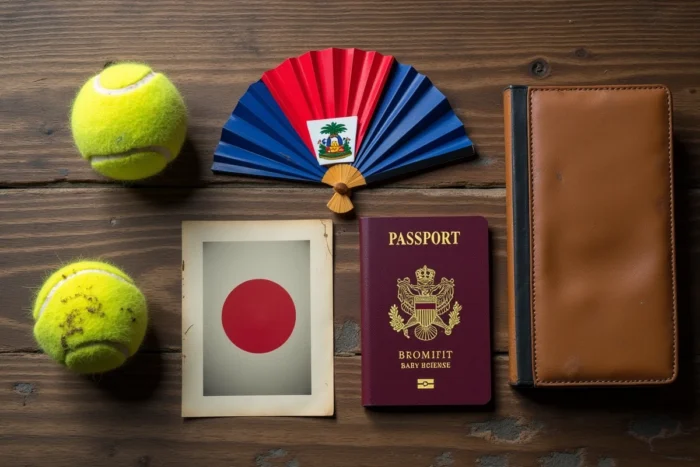
François’s educational approach is described as inherited from Haitian family culture: the importance of discipline, collective work, and resilience in the face of material obstacles. These values, transposed into the context of high-level tennis, created a family environment where sport was not separated from the rest of education.
The choice to give the girls their mother’s surname (Osaka rather than François) also illustrates a form of intercultural pragmatism. In Japan, this name facilitated social and administrative integration. On the international circuit, it anchored Naomi in a Japanese identity that was recognizable to sponsors and federations.
Naomi Osaka herself has publicly expressed her attachment to her two heritages. In 2026, as Haiti made a historic return to the World Cup after more than fifty years of absence, she shared her regrets about not being able to be in the United States to support the Haitian team. Such public statements directly extend the bicultural education established by her father.
Leonard François in 2026: A Role That Goes Beyond Tennis
The educational project in Morne Ogé is not an isolated case. Leonard François maintains active ties with Haiti, and his involvement in local initiatives signals an evolution of his public role. He is no longer just the coach who trained a Grand Slam champion, but an engaged actor in the development of his region of origin.
This trajectory remains less documented compared to that of his daughter. The available sources focus on Naomi, and Leonard François’s personal journey largely remains in the shadows. This informational imbalance reflects a family choice: Leonard has always prioritized media invisibility, allowing his daughters to occupy public space.
This discreet positioning should not obscure the extent of his influence. From Jacmel to Osaka, from New York to the courts of Roland-Garros, Leonard François has built a tricultural family project whose effects are measured as much in Naomi’s titles as in the renovated schools near his hometown.